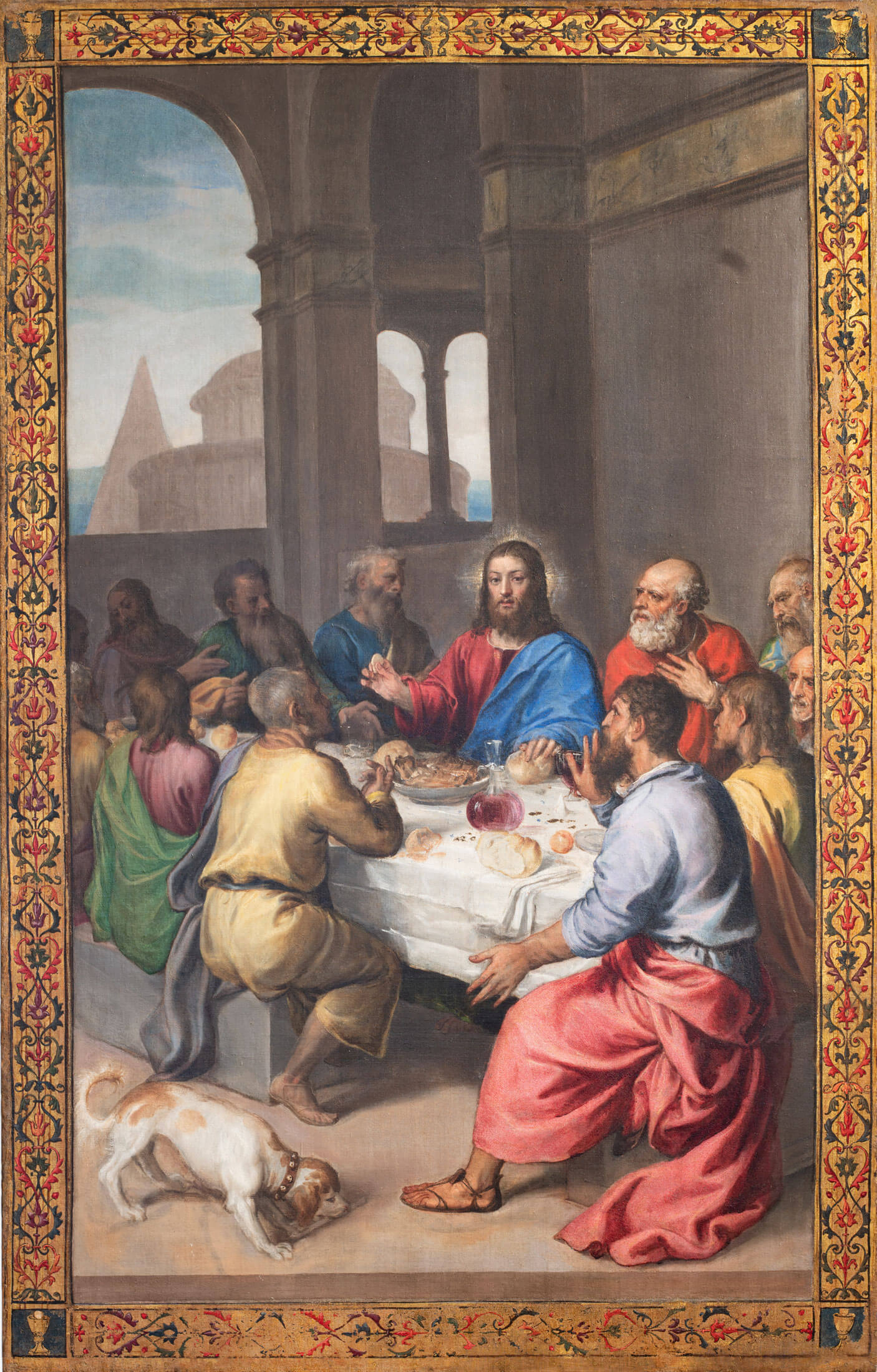
The Last Supper and the Resurrection of Christ by Titian were originally a processional banner commissioned from the artist by the Confraternity of Corpus Domini in Urbino. This masterpiece from Titian’s “middle period” (Dal Poggetto 2003) was created in Venice between 1542 and 1544, and it arrived in Urbino in June of the latter year, as evidenced by the payment documents preserved in the confraternity’s archives (L. Moranti 1990).
In 1545, the two sides of the banner were separated by the painter Pietro Viti, the son of the more famous Timoteo, to be displayed on either side of the high altar of the church of Santa Maria di Pian di Mercato, the congregation’s headquarters in Urbino. Pietro also painted candelabrum friezes in gold on the edges of the two canvases.
With the demolition of the church, which was sold by the confraternity to make way for the college palace commissioned by Clement XI, the paintings were moved to the church of San Francesco di Paola, the new location of the confraternity since 1708. In 1861, Giovanni Battista Cavalcaselle and Giovanni Morelli cataloged them during their survey of ecclesiastical heritage in the Marche and Umbria regions, and in 1866, the paintings were deposited in the museum of the Institute of Fine Arts in Urbino.
The theme of the Last Supper, due to its use as a banner, is represented vertically with a diagonal arrangement of the table, which features splendid still-life elements. The scene, with the animated gestures of the apostles, is set within an architectural frame of Lombard flavor. Beyond the archway and the mullioned window, there is a centrally planned building reminiscent of Bramante (W. Suida 1936) and a pyramid closely resembling the Pyramid of Cestius in Rome (H.E. Wethey 1969).
The Resurrection is divided into two parts. In the lower section, there is a great deal of agitation in the scene with the soldiers and the sarcophagus, which is executed with straight obliques and fractured lines that give motion and drama to the composition. Conversely, in the upper part, everything is calm and serene, and the blessing Christ rises into the dawn sky, with statuesque and Apollonian features. It’s a profound reflection by the artist from Cadore on the more animated Risen Christ in the Averoldi Altarpiece (G. Bernini Pezzini 1976) in the collegiate church of Saints Nazaro and Celso in Brescia, dated 1522.
The latest restoration, carried out in 2018 by the Higher Institute for Conservation and Restoration in Rome, has restored the brilliance and vivacity of the colors and the almost impressionistic touch of the brush, which had been concealed for many decades under oxidized varnishes. During the restoration, the painted frames by Vecellio were also uncovered, hidden by the candelabrum frieze by Pietro Viti. Traces of red and white paint from Viti’s frieze are now visible only on the sides of the two paintings.
Titian had created magnificent works for the Della Rovere family, including their portraits and numerous sacred subject paintings. Guidobaldo II Della Rovere, in particular, purchased one of the most famous paintings in art history from Titian in 1538: the sensuous Venus of Urbino, now housed in the Uffizi. With the devolution of the Duchy of Urbino to the Papal States in 1631 and the subsequent marriage of the family’s last descendant, Vittoria, to Ferdinando II de’ Medici, these masterpieces became part of the Florentine collections. Therefore, the banner is the only work by Titian that remains in Urbino.
Author: Tiziano Vecellio
Realization date: 1542
Storage location: Urbino, Galleria Nazionale delle Marche
Place of originFrom the church of Santa Maria di Pian di Mercato of the Corpus Domini brotherhood of Urbino
INV COD:DE 239
Dimensions: 163 × 104
Technique: Oil on canvas
Author: Tiziano Vecellio
Realization date: 1542
Storage location: Urbino, Galleria Nazionale delle Marche
Place of originFrom the church of Santa Maria di Pian di Mercato of the Corpus Domini brotherhood of Urbino
INV COD:DE 239
Dimensions: 163 × 104
Technique: Oil on canvas
The Last Supper and the Resurrection of Christ by Titian were originally a processional banner commissioned from the artist by the Confraternity of Corpus Domini in Urbino. This masterpiece from Titian’s “middle period” (Dal Poggetto 2003) was created in Venice between 1542 and 1544, and it arrived in Urbino in June of the latter year, as evidenced by the payment documents preserved in the confraternity’s archives (L. Moranti 1990).
In 1545, the two sides of the banner were separated by the painter Pietro Viti, the son of the more famous Timoteo, to be displayed on either side of the high altar of the church of Santa Maria di Pian di Mercato, the congregation’s headquarters in Urbino. Pietro also painted candelabrum friezes in gold on the edges of the two canvases.
With the demolition of the church, which was sold by the confraternity to make way for the college palace commissioned by Clement XI, the paintings were moved to the church of San Francesco di Paola, the new location of the confraternity since 1708. In 1861, Giovanni Battista Cavalcaselle and Giovanni Morelli cataloged them during their survey of ecclesiastical heritage in the Marche and Umbria regions, and in 1866, the paintings were deposited in the museum of the Institute of Fine Arts in Urbino.
The theme of the Last Supper, due to its use as a banner, is represented vertically with a diagonal arrangement of the table, which features splendid still-life elements. The scene, with the animated gestures of the apostles, is set within an architectural frame of Lombard flavor. Beyond the archway and the mullioned window, there is a centrally planned building reminiscent of Bramante (W. Suida 1936) and a pyramid closely resembling the Pyramid of Cestius in Rome (H.E. Wethey 1969).
The Resurrection is divided into two parts. In the lower section, there is a great deal of agitation in the scene with the soldiers and the sarcophagus, which is executed with straight obliques and fractured lines that give motion and drama to the composition. Conversely, in the upper part, everything is calm and serene, and the blessing Christ rises into the dawn sky, with statuesque and Apollonian features. It’s a profound reflection by the artist from Cadore on the more animated Risen Christ in the Averoldi Altarpiece (G. Bernini Pezzini 1976) in the collegiate church of Saints Nazaro and Celso in Brescia, dated 1522.
The latest restoration, carried out in 2018 by the Higher Institute for Conservation and Restoration in Rome, has restored the brilliance and vivacity of the colors and the almost impressionistic touch of the brush, which had been concealed for many decades under oxidized varnishes. During the restoration, the painted frames by Vecellio were also uncovered, hidden by the candelabrum frieze by Pietro Viti. Traces of red and white paint from Viti’s frieze are now visible only on the sides of the two paintings.
Titian had created magnificent works for the Della Rovere family, including their portraits and numerous sacred subject paintings. Guidobaldo II Della Rovere, in particular, purchased one of the most famous paintings in art history from Titian in 1538: the sensuous Venus of Urbino, now housed in the Uffizi. With the devolution of the Duchy of Urbino to the Papal States in 1631 and the subsequent marriage of the family’s last descendant, Vittoria, to Ferdinando II de’ Medici, these masterpieces became part of the Florentine collections. Therefore, the banner is the only work by Titian that remains in Urbino.